B Vitamins
Today, the B vitamins include eight water-soluble vital substances known as vitamins B1, B2, B3, B5, B6, B12, biotin and folic acid. In contrast to other vitamins, the B vitamins cannot be stored in the body over a longer period of time and must therefore be supplied daily through food. The only exception is vitamin B12, which can be stored in the liver.
Some of the B vitamins work very closely together and their effects are interdependent; it is therefore important to ensure an adequate supply of all B vitamins. As the B vitamins are distributed across all food groups, only a very balanced diet provides all B vitamins in sufficient quantities. Consequently, even large nutritional studies repeatedly show significant gaps in the supply of B vitamins.
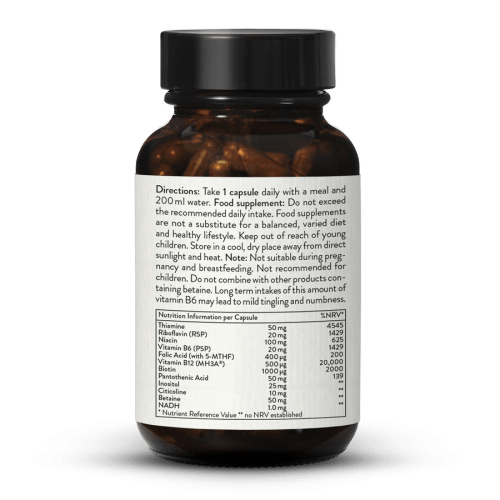
High-Dose B Complex Forte with Four Cofactors
Directly bioactive forms of all eight B vitamins ensure optimal and direct bioavailability and effectiveness. The B vitamins are present as bioidentical forms and active coenzyme forms. The cofactors choline, betaine, inositol and NADH, which were formerly also counted among the B vitamins, additionally improve the bioavailability and effectiveness of all the B vitamins in the complex.
- Thiamine (B1) is involved in energy production and the normal function of the nervous system and psychological function.
- Riboflavin (B2) plays a role in energy production and the reduction of tiredness, the maintenance of healthy skin and mucous membranes, and the protection of cells and DNA from oxidative damage.
- Nicotinamide (B3) is involved in the synthesis of serotonin and melatonin from L-tryptophan and is needed for the function of the nervous system, psychological function, energy, tiredness, skin and mucous membranes.
- Pantothenic acid (B5) plays a role in the energy production of the mitochondria and is needed for the synthesis of proteins, cholesterol, steroid hormones and neurotransmitters, as well as for the metabolism of vitamins A and D.
- Pyridoxine (B6) is the key vitamin for amino acid utilisation and is involved in the immune system, hormonal activity, the nervous system, energy metabolism and the formation of red blood cells.
- Biotin (B7) contributes to the maintenance of normal skin, mucous membranes and hair, as well as to the normal function of energy-yielding metabolism, the nervous system and the metabolism of macronutrients.
- Folate (B9) plays a role in cell division, blood formation, amino acid metabolism and homocysteine metabolism, and is essential for the healthy development of the foetus.
- Vitamin B12 (cobalamin) is needed for the formation of red blood cells and for building DNA and proteins.
Alongside the eight essential B vitamins, there are several other vitamin-like nutrients that work closely with the B vitamins as cofactors, and which until recently were counted among the B vitamins themselves.
- Choline (formerly vitamin B4) is found mainly in the form of phosphatidylcholine (lecithin) and acetylcholine.
- Betaine (as trimethylglycine/TMG) is a further, activated form of choline.
- Inositol (formerly vitamin B8) is found mainly in the brain, liver and kidneys.
- NADH (nicotinamide adenine dinucleotide hydride, the active form of vitamin B3 (niacin), also called "coenzyme 1") is involved in numerous redox reactions in the cell's metabolism.
B vitamins contribute:
- to the maintenance of normal skin and mucous membranes
- to the maintenance of normal hair
- to the maintenance of normal psychological function
- to normal metabolism of macronutrients
- to normal energy-yielding metabolism
- to the normal function of the nervous system
- to normal heart function
- to the maintenance of normal iron metabolism
- to the maintenance of normal red blood cells
- to the protection of DNA, proteins and lipids from oxidative stress
- to cell division
- to the maintenance of normal cysteine synthesis
- to the maintenance of normal amino acid synthesis